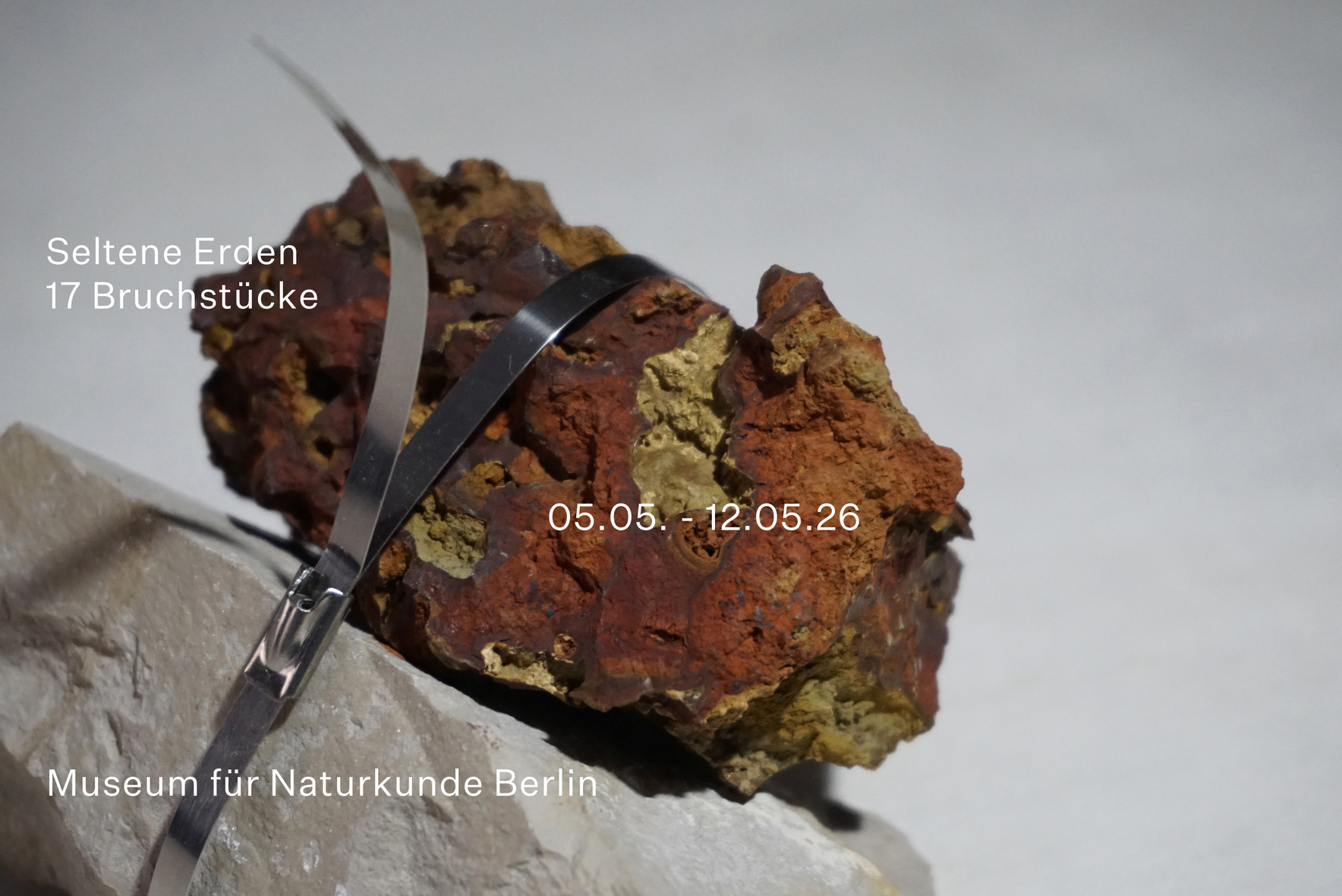
In May 2026, Philine Rinnert, in collaboration with Netzwerk Naturwissen, will open a temporary excavation site on the grounds of the Museum für Naturkunde Berlin. It will be created as a resonance space for the 17 Rare Earth Elements. Photographs, sketches and models, light and sound are used to create 17 fragments: visible, invisible, auditory, tactile, performative and participatory approaches. Together with percussionist Sabrina Ma, the space regularly comes to life: matter is set to music, the invisible becomes audible, names become music, sound becomes fragile.
Rare earths are a group of 17 special metals. They are essential for the global energy transition. However, their production is highly harmful to the environment and health. The EU does not mine rare earths itself, but sources 90% of them from the Chinese market. The rarity of their extraction is also a pawn in the balance of power.
The intervention explores zones of transition, at the boundaries of perception, in the noise between knowledge and ignorance, in the movement between surface and depth. Visitors to this temporary excavation site are not consumers of ready-made meanings, but co-creators. They move through a terrain of traces, fragments, frequencies, and become actors themselves. The excavation site is also a space for communication: guests are invited to enter into dialogue with us and the space.
In addition to the workshop, there will be discussion rounds with various thematic focuses, with geologists, journalists, museum employees, politicians, representatives from the business world, and artists.
In a world where the invisible becomes a political issue, our relationship with the earth is often one of empty spaces. The intervention opens up these empty spaces, not to fill them, but to endure them. As spaces of resonance for that which eludes us. For perhaps insight begins precisely where seeing reaches its limits.